Table of Contents
- Quick Comparison
- Protect Your Connection With Secure VPN
- 1. Which VPN Covers More Streaming Regions?
- 2. What Can You Actually Watch?
- 3. What About Popular Movies and Shows?
- 4. Which One Is More Stable?
- 5. Which Is Better for HD and 4K?
- 6. NordVPN vs ExpressVPN for Netflix
- 7. What About Disney+, Prime Video and BBC iPlayer?
- 8. Which Is Better for Smart TVs?
- 9. NordVPN or ExpressVPN: Which One Should You Choose?
- Final Words
If you mainly want a VPN for watching movies and TV shows, the usual NordVPN vs ExpressVPN comparison needs to focus on more than speed.
What really matters is whether the VPN can connect to the streaming service you want, which regions it supports, how stable the connection is, and whether you can watch in HD or 4K without constant buffering.
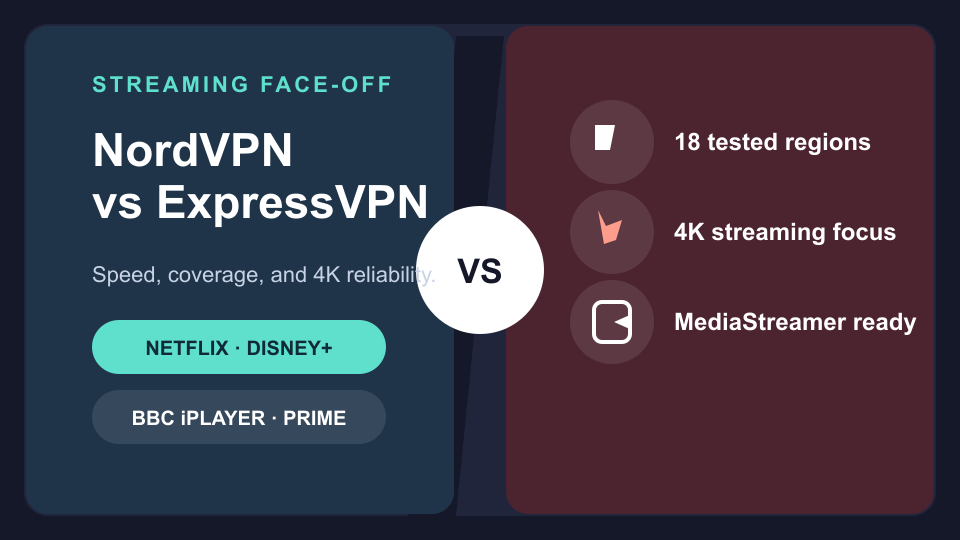
Based on current independent testing, both are strong streaming VPNs. ExpressVPN has a slight advantage in overall streaming coverage, while NordVPN is particularly attractive if you care about speed and using multiple devices.
Quick Comparison
| Streaming feature | ExpressVPN | NordVPN |
|---|---|---|
| Netflix regions tested | 18 | 17 |
| Major streaming services | 115/120 tested | Strong coverage |
| HD streaming | Yes | Yes |
| 4K streaming | Yes | Yes |
| Long-distance streaming | Very stable | Very stable |
| Netflix US | Yes | Yes |
| Netflix UK | Yes | Yes |
| Netflix Japan | Yes | Yes |
| Netflix Singapore | — | Yes |
| Disney+ | Yes | Yes |
| Prime Video | Yes | Yes |
| BBC iPlayer | Yes | Yes |
| Hulu | Yes | Yes |
| Fire TV / Android TV / Apple TV | Yes | Yes |
| Simultaneous connections | Up to 8 | Up to 10 |
Testing results can change as streaming platforms update their VPN detection, so these figures should be treated as current test results rather than permanent guarantees.
Protect Your Connection With Secure VPN
If you often use public Wi-Fi or stream movies while traveling, Secure VPN can add an extra layer of privacy to your internet connection. It helps encrypt your connection and keeps your browsing activity more private on networks you don't fully trust. It's a simple option if you want more privacy without dealing with complicated VPN settings.
1. Which VPN Covers More Streaming Regions?
This is one of the biggest differences if you watch international content.
ExpressVPN currently has access to 18 Netflix regional libraries in Top10VPN's testing. These include popular locations such as the US, UK, Canada, Japan, India, Australia, Brazil and Germany. It also unblocked 115 of 120 streaming services tested by the same site.
NordVPN also has broad Netflix coverage, with 17 regions verified in current testing. Its tested locations include the US, UK, Japan, Canada, Singapore, Australia, Brazil, Germany, France and Mexico.
So the difference is not huge.
If you regularly jump between different countries' libraries, ExpressVPN has the small advantage on tested coverage.
If you mainly need popular regions such as the US, UK, Japan or Singapore, either service can be a good fit.
2. What Can You Actually Watch?
Both VPNs work with the major streaming platforms people usually care about.
Current tests show support for services such as:
- Netflix
- Disney+
- Amazon Prime Video
- BBC iPlayer
- Hulu
- HBO Max
- Paramount+
- Peacock
- ESPN and other sports services
ExpressVPN's current streaming tests also include platforms such as JioHotstar in India, Kayo Sports in Australia, Sky Go in the UK and Crave in Canada.
That means the difference is not simply "Netflix works on one but not the other."
The more useful question is how many regions and services you expect to use.
For example, someone who wants to watch Netflix US, UK or Japan occasionally probably won't notice much difference. Someone who frequently switches between US, European and Asian catalogs may get more value from ExpressVPN's broader tested coverage.
3. What About Popular Movies and Shows?
A VPN does not give you a subscription to Netflix, Disney+ or another streaming service. You still need an account where required, and the titles available to you depend on the service's current catalog and licensing.
The benefit is that, where the service permits VPN use and the connection works with that region, you may see a different catalog.
For example, Netflix libraries can contain different titles depending on the country. Popular movies such as The Batman, Dune, Barbie, John Wick or major Netflix originals can therefore appear differently across services and regions.
The same applies to TV shows. BBC iPlayer is useful for UK programming, Hulu has a large US-focused catalog, while Disney+ is particularly relevant if you watch Marvel, Star Wars, Pixar or Disney titles.
Because streaming rights change regularly, it is better to check the current catalog on the streaming service rather than assume that a particular movie will always be available in a certain country.
4. Which One Is More Stable?
Stability matters more than maximum download speed when you are watching a two-hour movie.
A VPN can have an impressive speed-test result but still be frustrating if a streaming server gets detected halfway through a session or you constantly need to reconnect.
Current independent testing gives both services strong results here.
ExpressVPN is particularly well regarded for consistent long-distance streaming, and Top10VPN currently rates it highly for stable streaming speeds.
NordVPN is also very reliable with major streaming services. Current testing found it working with Netflix, BBC iPlayer, Disney+, Prime Video and other major platforms, with strong playback even on distant servers.
There is no clear winner for every location.
Your experience can depend on the country you connect from, the server you choose and whether a streaming service has recently blocked particular VPN IP addresses.
5. Which Is Better for HD and 4K?
Both are fast enough for normal HD streaming and 4K when your underlying internet connection is fast enough.
ExpressVPN's current Netflix testing reports smooth 4K streaming, while NordVPN is also rated highly for HD and 4K performance.
For most people, this means you should not choose between them simply because one says "4K" and the other does not.
The more important question is what happens when you connect to a server far away.
For example, if you are physically in Asia but connecting to a US or European server, the extra distance can affect speed and latency. NordVPN has performed extremely well in several independent speed tests, while ExpressVPN has also shown strong long-distance performance.
In practical terms:
100 Mbps connection + 4K TV + nearby VPN server: either should be more than enough.
Slower connection + distant server + 4K streaming: server selection and connection stability become much more important.
6. NordVPN vs ExpressVPN for Netflix
Netflix is probably the easiest way to see the difference between these two VPNs.
ExpressVPN currently has 18 tested Netflix regions, including the US, UK, Canada, Japan and India.
NordVPN has 17 tested regions, including the US, UK, Japan, Singapore, Brazil, Australia, Canada and Germany.
Both are therefore good choices for Netflix.
The difference is small, but ExpressVPN gets the edge if international Netflix coverage is your main reason for buying a VPN.
NordVPN can still be the better choice if you mainly use popular Netflix regions and place more importance on connection speed.
7. What About Disney+, Prime Video and BBC iPlayer?
For major services outside Netflix, the gap becomes even smaller.
Both VPNs have been tested successfully with Disney+ and Amazon Prime Video, while BBC iPlayer is also supported.
This makes both suitable for a typical movie-and-TV setup.
If your watch list includes Marvel movies on Disney+, Prime Video movies and series, Netflix originals, or BBC programs, you do not need to choose one simply because of platform compatibility.
The decision becomes more interesting if you regularly use less common regional services.
That is where ExpressVPN's broader tested service coverage gives it an advantage.
8. Which Is Better for Smart TVs?
Both services support major streaming devices, including Fire TV, Android TV and Apple TV.
ExpressVPN also offers MediaStreamer, its Smart DNS option, which can be useful on devices where installing a full VPN app is not practical.
NordVPN has a similar SmartPlay system.
This matters if your setup is more complicated than simply watching Netflix on a phone or laptop.
For example, if you watch movies on a living-room TV, Fire TV Stick or Apple TV, having a proper TV solution can make the difference between connecting in seconds and spending time configuring a router.
9. NordVPN or ExpressVPN: Which One Should You Choose?
There is no huge gap between them, but the better choice depends on what you watch.
Choose ExpressVPN if:
- You regularly watch content from different countries
- Netflix region coverage is important
- You use several international streaming services
- You want a simple setup for TV streaming
- You care more about consistency than getting the absolute highest speed
Choose NordVPN if:
- You mainly use popular services such as Netflix, Disney+ and Prime Video
- Speed is one of your biggest priorities
- You want up to 10 simultaneous connections
- You use several devices around your home
- You want strong streaming performance without paying specifically for the widest regional coverage
Final Words
Both are excellent choices for streaming. ExpressVPN is the better pick for wider streaming coverage, while NordVPN is a great option if speed and multiple devices matter more.